Where the Light Learned My Name – Part I
Chapter Two: Communion
Sundays were my second favorite day of the week. Fridays belonged to my father. Sundays belonged to church.
Cora hated Sundays.
I woke up excited. We wore matching dresses and Mother curled our hair. I loved the feel of warm fingers twisting curls into place.
Cora did not. Each time Mother finished a curl, Cora dragged her fingers through it, undoing the work with a laugh as Mother’s patience thinned. Eventually, her hair would be brushed out and left uneven, straight in places and tangled in others. Then, after Mother gave up on it, we would go.
After stepping inside the small building, I ran to Grandma Great as soon as I saw her, breathing in her sweet perfume and spearmint gum, wrapping my small arms around her as if I could anchor myself there. Everyone was still standing, greeting each other and catching up on the week’s events. Church felt bright to me—full of music and voices and stories that lifted my spirit.
Cora was uncharacteristically quiet at church gatherings. I didn’t understand why. I only knew something in her shifted the moment we got inside.
We sat in our usual places: me on Grandma Great’s lap, Cora beside us, Mother on the other side.
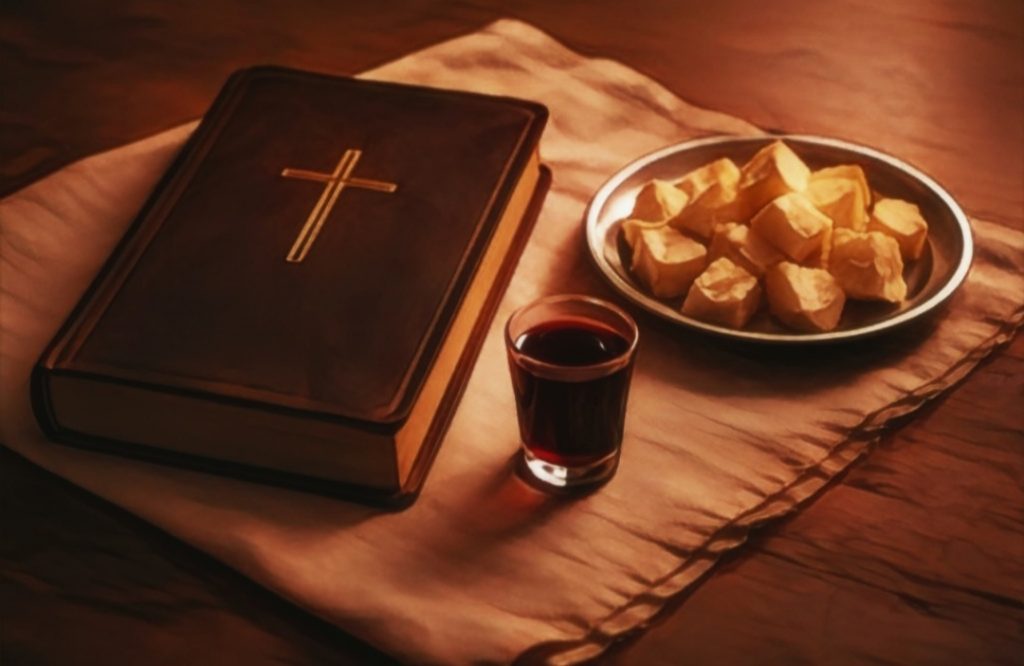
Our Pastor announced it was time for communion. We were all handed shots of red grape juice and a small piece of bread. The juice represented the blood of Jesus shed by his sacrificial death. The bread, which fulfills physical hunger, represented the nourishment of spiritual hunger. It was supposed to be a moment of gratitude and reflection.
It didn’t last.
After Cora was handed her grape juice, she stood abruptly and shouted, “I CURSE THE BLOOD OF JESUS!”
She then slowly poured the juice onto the carpet while staring at the Pastor and threw down the tiny plastic cup, grinding it beneath her shoe.
The church went silent.
Every face turned toward us. Mother froze, not even breathing, her expression tight with horror. Grandma Great reached out and touched Cora’s arm, her voice rising as she prayed for Jesus to release whatever had taken hold of the child.
Cora slapped her hand away and laughed, repeating her words back in a tone of mockery.
One by one, people stood and began moving towards us until we were surrounded by a circle of voices, prayers overlapping and growing louder, Cora at the center of it all.
I stayed on Grandma Great’s lap, stiff and small, eyes wide, my hands knotted together. I didn’t understand what was happening. I only wanted it to stop. I closed my eyes and prayed silently for help.
Moments like this were not uncommon at home. Cora often mocked the Bible and the church. But this was the first time she had shouted during a ceremony. We usually listened to the Pastor, but this time, the service unraveled around us, reshaping itself into urgent prayer.
We stayed long past the usual hour.
Nothing seemed to calm her. She mocked every prayer, laughing loudly against their voices, and even tried to bite some of their hands as they reached out to her.
Eventually, Mother—who had been silently crying the whole time—announced that we needed to leave. As we gathered our things, hands reached out to touch her shoulders, her arms, her back. Some offered comfort. Others offered advice. One woman suggested a psychologist.
Mother pulled away. “She’s just a child,” she said sharply. “You don’t understand children.”
Usually, when there was a Sunday without incident, we stayed for potluck after church.
This time, we didn’t. We went instead to Grandma Great’s apartment, just a short drive away.
She cooked dinner while we watched television in the living room. I stayed close to Nini, her white poodle, running my fingers through the soft fur behind her ears. The screen distracted us with silly cartoon characters, a bright contrast to the heaviness that had followed us home.
Mother stood in the kitchen with Grandma Great. Their voices were low, careful, but every so often Mother’s words rose sharply before dropping again. I didn’t catch everything they said, but I understood well enough. They were talking about Cora.
I focused on Nini and tried to think of happy things.
I often spent the night alone at Grandma Great’s house, and we’d stay up late giggling like school children. This was also where I learned about makeup, as I’d often get into her things and start applying lipstick, wearing her jewelry, and attempted walking around in her high heels. Every time she caught me, I stopped breathing for moment, fearing I was in trouble—but instead she’d smile warmly and then teach me how to do things properly.
She was always happy to be with me. She would give me ice cream, and we watched television together or she would read the Bible to me. We would go to bed late and stay awake even later.
Sometimes she had random bouts of gas and there’d be a sudden long, loud noise as we lay in the darkness and silence, to which I’d gasp, and she’d say, “Oh my God, who let that frog in here?!” Realizing what had happened, I’d start laughing and then we’d laugh together until it hurt. The years between us disappeared in those moments – we were at the same level. These were some of the best days of my life.
Grandma Great knew it was hard for my mother to get work because no one would babysit Cora, so eventually she offered to help. After a while, Mother got hired somewhere, so Grandma Great came over to our place to watch over us.
Whenever it came time for Mother to leave, it was a scene to behold: Cora, screaming at the top of her lungs, as Grandma Great held her tightly, Cora slightly lifted off the ground, kicking her legs as hard as she could, trying everything possible to stop our mother from leaving.
When she couldn’t break free, she began biting Grandma Great’s arms in attempt to free herself. Mother watched anxiously, trying not to cry, and Grandma Great would say, “Go, just go! I’ll take care of them!”
We needed money, and Mother needed work, so she had to get past this. Somehow, Cora had to accept the separation. But their bond was intensely strong; perhaps something beyond mother and daughter. Cora had a certain control over our mother, and it was obvious in moments like this.
Eventually, Mother would turn around and close the door behind her. Cora continued screaming and kicking, leaving our poor grandmother covered in bite marks and bruises, but she never gave in. She held Cora until our mother’s car was completely out of earshot.
Defeated, Cora fell to the ground and began pounding her fists on the floor in anger. She growled angrily at our grandmother and ran upstairs to her room. She refused to come out until Mother got home.
If we made food, I would take it to Cora’s room, but she wouldn’t respond to my knocking. Then I would set the plate on the carpet, leave, and collect the empty dish later.
I spent these solitary moments peacefully with Grandma Great, so I didn’t mind Cora staying in her room. In truth, it was a relief to have a break from her unpredictable behavior and fragile temper.
During these visits, Grandma Great often shared stories about her life or her dreams—her literal dreams. Many people suggested that she was psychic; she occasionally seemed to dream things before they happened. Sometimes the dreams involved me or other family members. If she shared those ones, she always told me to keep them to myself.
One such dream stayed with me.
She told me that she and I were walking hand in hand along a winding path, moving toward an unknown destination. All around us was darkness. Only the path was flooded with light. We felt calm and certain, trusting where the path would lead us. Suddenly, out of the shadows, we came upon a swamp—dark, still, and deep. Curious, I let go of her hand and moved toward the water. She called out to me urgently, warning me to stay on the path, but I didn’t listen. I wanted to see what was in the water.
Leaning over, I slipped and fell in. The water swallowed me quickly, and I began splashing, trying to keep my head above the surface. Grandma Great ran to the edge and reached for me, but I was busy trying to save myself and it was hard for her to grab me. I drifted farther away, my ears filling with water until I could no longer hear her calling my name.
Then the dream ended as she woke.
She told me the dream meant that one day, life might pull me away from the path of goodness—and that how I responded to my experiences would shape who I became. I could find my true path, or I could drown in darkness.
I didn’t understand the weight of her words then. Later, I understood them completely.
One sunny afternoon, Mother took us to Grandma Great’s apartment for dinner. Cora and I played in the bathroom while Mother helped prepare the meal. I showed Cora how to apply makeup, guiding her small hands clumsily across her face. It wasn’t good, but she watched herself in the mirror with interest.
From the kitchen, we heard Mother’s voice rise in alarm.
Money had gone missing from her purse — eighty dollars.
I looked at Cora. I thought about how to ask her about it without becoming the enemy.
I chose my words carefully. “If you know where the money is,” I said quietly, “I won’t tell Mother. But it’s important to be honest. Honesty is how you know you’re a good person. It’ll just be between us. Do you know where it is?”
She studied my face for a long moment. Then she reached into her small bag and pulled out the money. Alongside it was some of Grandma Great’s jewelry. She handed me the bills. I looked at the jewelry without speaking, and she tipped the bag, spilling everything onto the counter.
“I won’t tell on you,” I said. She nodded.
I peered out of the bathroom doorway. Mother was searching everywhere—under cushions, in drawers, emptying her purse again and again. Her frustration was visible now. She returned to the kitchen, close to tears, speaking to Grandma Great, who was preparing to stop cooking and help her look.
I slipped into the living room and tucked the money beneath a throw pillow on an armchair. Then I went back to the bathroom.
“What did you do with it?” Cora asked.
“I put it somewhere they’ll find it,” I said. “It’s the right thing to do, Cora. It doesn’t belong to us.”
“If it belongs to Mother, it belongs to us too,” she said. She sounded regretful now.
“We don’t work or make money. Mother needs that money. It’s not for us to decide how to spend it. Maybe it’s for food or toys. But if you take it, Mother can’t buy us anything. Don’t you see? It’s better for Mother to have it.”
At the mention of toys, her face lit up. I thought about lecturing her on not going through Mother’s purse too, but since I had won her trust, I decided to drop it and accept what I had already accomplished. If I pressured her more, she might become angry.
Grandma Great found the money soon after.
“You must have dropped it here earlier,” she said gently.
Mother looked confused but relieved. “That’s for the power bill,” she said, her voice breaking. “We could’ve lost power.”
Grandma Great rested a hand on her back. “You can always ask the family for help.”
Mother didn’t answer.
After dinner, the adults stayed in the kitchen. Cora grew sleepy and stretched out on Grandma Great’s bed. I sat in the living room, cartoons flickering across the screen without holding my attention.
Mother and Grandma Great lowered their voices.
I knew I shouldn’t listen, but curiosity pulled me closer. I stood just outside the doorway, careful to stay unseen.
They were talking about Cora’s father.
“He knew I was pregnant,” Mother said. Her voice sounded heavy. “Somehow, he knew before I told him. That’s when he left.”
Grandma Great answered gently, but there was firmness beneath it. “He wasn’t good to begin with. I dreamed he was a snake—poisoning you. I think you were better off without him.”
“I thought he understood me,” Mother said quickly. “We both had so much pain.”
“Yes,” Grandma Great said, “but his childhood was terrible. Something like that can change a person. Especially when it happens so young.”
Mother inhaled sharply. “It was in the newspapers. He was left alone there for three days.”
“Three?” Grandma Great asked. “He had a baby brother, didn’t he?”
Mother hesitated. Then she continued.
“His mother was having an affair. His father found out and came home early with a shotgun. She hid Derek under the bed and put his baby brother in a drawer. He shot her, her lover, and then himself. Derek was only three years old. He stayed under that bed for three days before anyone found him.”
The room went quiet.
“Do you think,” Grandma Great asked softly, “that’s why Cora is the way she is?”
Something struck the table—not hard, but final.
“There is nothing wrong with Cora,” Mother said. “She’s only five. Children are children.”
Grandma Great was quiet, but eventually said, “I hope that’s true. Come now, let’s finish up.”
Chairs scraped against the floor. I hurried back to the television and sat very still.
The images on the screen blurred as I imagined the story I had just heard. I knew I could never repeat it. I also knew I was not meant to carry it.
Still, questions formed anyway. Was Cora born this way? Did she have a choice?
I thought about all the times she’d been sent home from school for saying mean things to her classmates or even giving secret notes to the boys in her class that Mother wouldn’t share with me. Many parents had called Mother and told her to keep Cora away from their sons and daughters.
Cora had no friends. She didn’t seem to care.
I thought of the pets Father had given me—how they always died soon after arriving, and how Cora laughed whenever Mother told me. I thought of the way she watched people, as if studying them.
When Cora did something wrong, I could often get the truth from her—but only because I didn’t tell anyone else. There was something inside of me that offered guidance when dealing with Cora. Something that told me what to say, how to act, and how to keep her from hurting me. How to make her trust me.
Mother’s words echoed in my mind. “No matter what.”
She was my sister. I loved her.
But something felt unsettled, as if love meant learning to disappear a little at a time.
I didn’t have words for it yet.
I only knew that being safe, in this house, often meant being quiet.